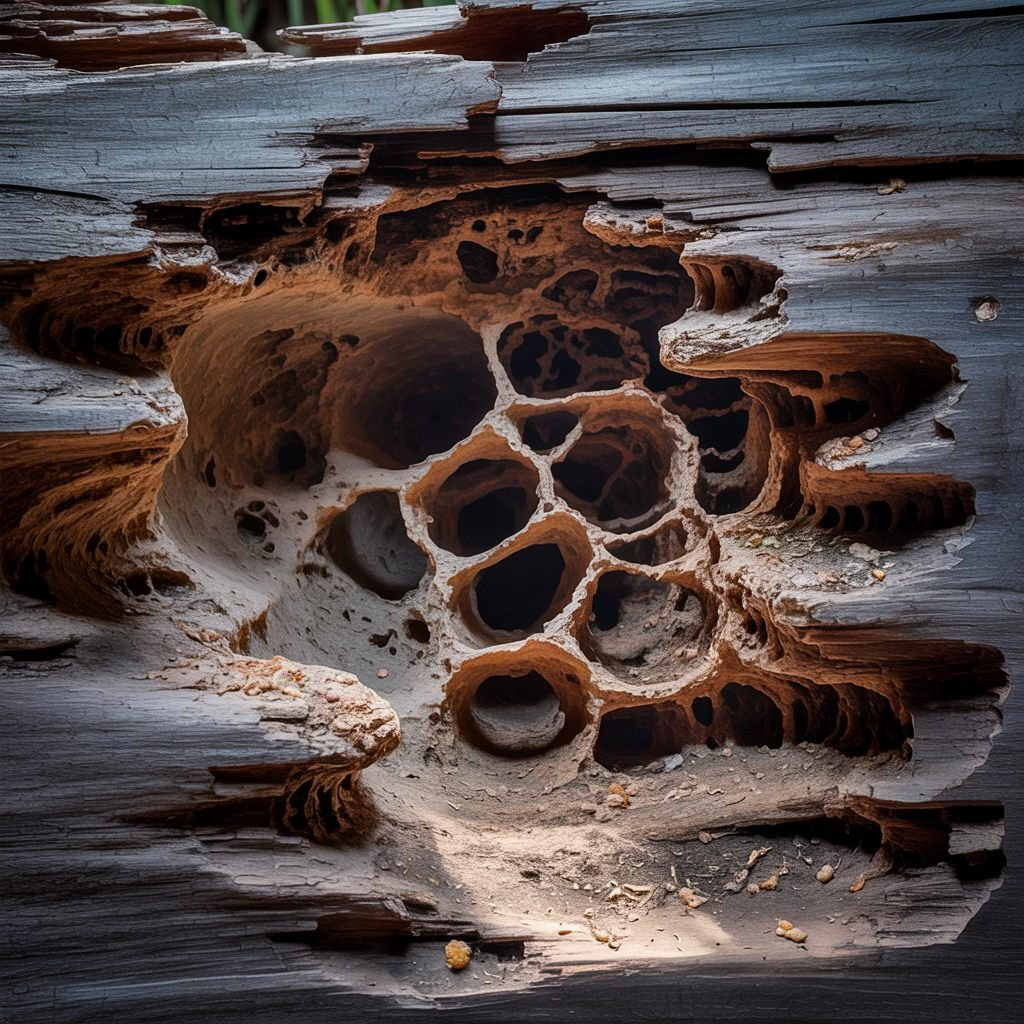
You found sawdust near a windowsill or heard a faint rustling in the wall, and now you're staring down two very different bills: carpenter ants or termites? Both damage the wood in a Dallas home, but they do it in completely different ways and need completely different treatments. Here's how to tell them apart before you spend money on the wrong fix.
The core difference: eating vs. excavating
Termites eat wood. They consume the cellulose for food, tunneling through the grain and leaving galleries packed with soil (subterranean) or lined with pellets (drywood). Carpenter ants don't eat wood — they excavate it to build nests, chewing out smooth galleries and pushing the debris out. That one distinction drives everything else, including how you treat it and how urgent it is.
Look at the “sawdust”
The debris tells the story. Carpenter ants leave frass that looks like coarse sawdust mixed with insect parts and bits of dead ants — dry and fibrous. Termites leave either mud (subterranean, packed in tunnels) or hard, ridged pellets like coffee grounds (drywood). If the pile looks like clean wood shavings with ant fragments in it, think carpenter ants. If it looks like tiny uniform pellets or there are mud tubes on the foundation, think termites. Our termite types guide covers the termite signs in detail.
Look at the insect
| Carpenter ant | Termite (swarmer) | |
|---|---|---|
| Waist | Pinched, narrow | Straight, no waist |
| Antennae | Bent (elbowed) | Straight |
| Wings | Front wings longer than back | Four equal-length wings |
| Color | Usually dark/black | Pale, creamy |
If you catch a winged one in spring, those four features settle it quickly. Both swarm, so seeing flying insects around the house isn't enough on its own.
Which is more urgent?
Termites are generally the bigger structural threat — they work in large colonies and can compromise framing over time, which is why they warrant fast action and annual inspection. Carpenter ants damage wood more slowly, but they carry an important clue: they nest in moist or previously damaged wood, so a carpenter ant nest often points to a hidden moisture problem — a roof leak, plumbing leak or poor drainage — that's worth fixing alongside the ants. Either way, both are worth addressing, because both get worse the longer they're ignored.
How treatment differs
Carpenter ants are treated like other ants — non-repellent products and baits that reach the nest and queen, plus correcting the moisture that drew them in. See ant control. Termites are treated at the source: a liquid soil barrier or bait system for subterranean, localized treatment or fumigation for drywood. See termite control. Using an ant product on termites (or vice versa) wastes money and leaves the real problem active — which is exactly why identification comes first.
Quick answers
Do carpenter ants cause as much damage as termites?
Usually less and more slowly, since they excavate rather than eat wood — but a large, long-established carpenter ant nest can still cause significant damage, and it flags a moisture issue.
I see big black ants indoors — is that carpenter ants?
Large dark ants indoors, especially near moisture or with sawdust piles nearby, are a strong sign of carpenter ants. An inspection confirms the nest location.
Can I have both?
Yes — a home with moisture problems can attract both. An inspection identifies what's actually present so you don't treat one and miss the other.
Where each one shows up in a Dallas home
Location is another clue. Subterranean termites — by far the most common in North Texas — come up from the soil, so they show up at ground contact: the foundation, the sill plate, garage door frames, porch posts and any wood touching dirt. Our clay soils and slab construction give them plenty of access. Carpenter ants go the other way, nesting where wood stays damp: around leaky windows and roof flashing, under bathroom and kitchen fixtures, in hollow doors and wall voids near plumbing, and in dead tree limbs and stumps outside that then serve as a launch point into the house. If you're finding the problem up high near a roof leak, lean carpenter ants; if it's low near soil contact with mud present, lean termites.
What it costs to be wrong
The reason identification is worth doing carefully is that guessing wrong is expensive in both directions. Treat a termite problem as carpenter ants and you leave an active colony eating your framing for months. Treat carpenter ants as termites and you pay for termite work while the real moisture-and-ant issue keeps going. A professional inspection settles it in one visit, points to any hidden moisture problem behind the ants, and matches the treatment — and the cost — to what you actually have. See our pricing guide for what each service typically runs.
Found sawdust or winged insects and not sure which you have? Book a free inspection and we'll identify it and match the treatment to the actual pest.
Dealing with this in your Dallas home?
A free inspection identifies the pest, the entry points and an exact quote — no obligation.